Saturday, April 23, 2016
Reducing military spending will make us more secure.
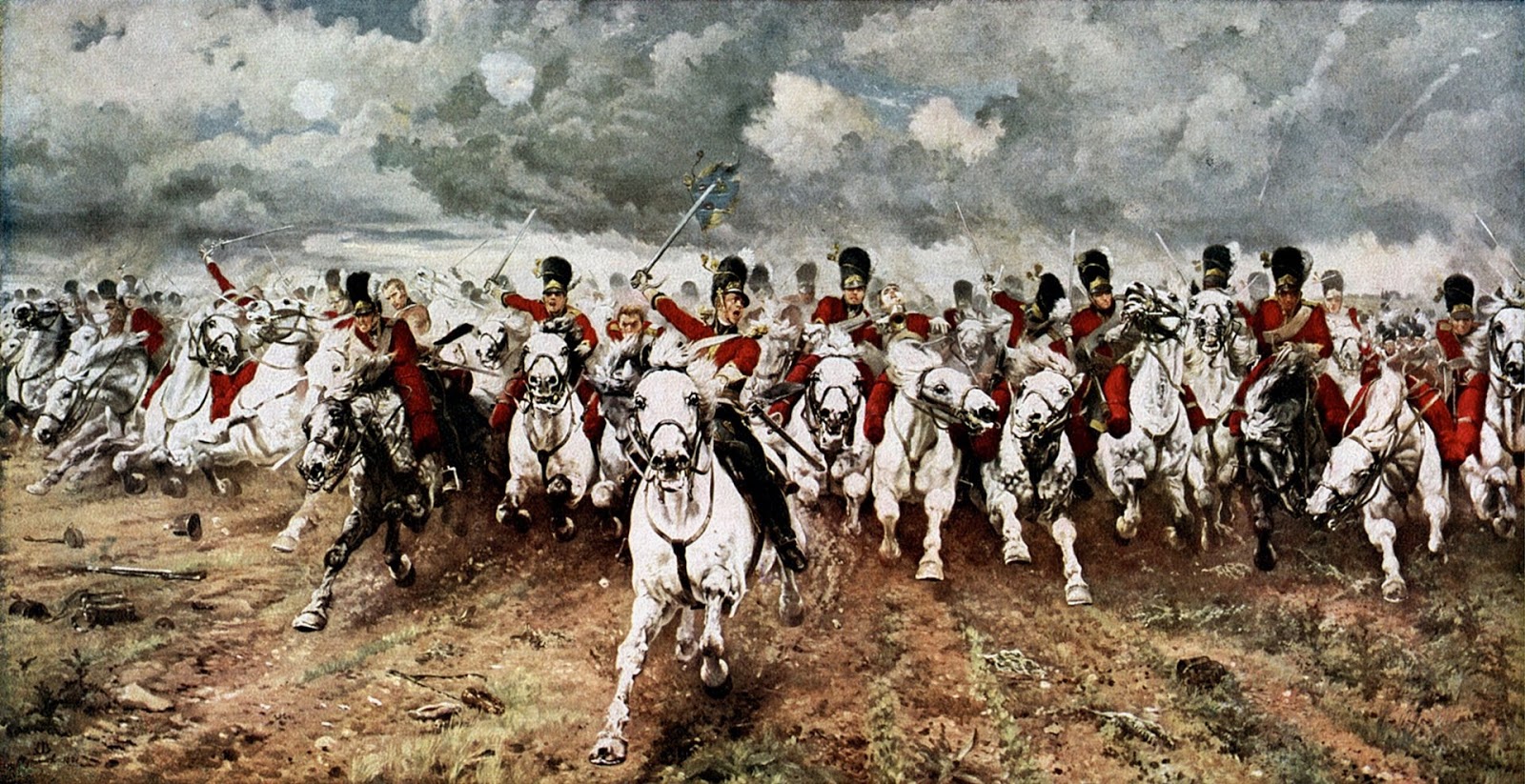
With England's "Glorious Revolution" of 1688, England permanently established its independence from French influence. At the time, England's population and economy were roughly half the size of France's. What followed was a 127 year war of attrition for world domination that ended at Waterloo in 1812 with England's victory over France. How did England pull this off? I think is came down to one thing. The English people viewed their government as more legitimate because it downsized its military during peacetime.
The war with France was actually a series of wars between periods of peace. During the times of peace, the English government would reduce spending and the economy would grow. This legitimized the English government and enable it to raise taxes in wartime. The English aristocracy was willing to pay these taxes because they were temporary and necessary. The English government was thus able to match France's spending during wartime even though its economy was much smaller. The French monarchy was much more corrupt and did not reduce spending in peace time. During wartime, the French aristocracy was not willing to pay taxes because they felt their money would be wasted and that it would only lead to more taxes. As a result, by the time the French finally got rid of their monarchy in 1789, England's economy had grown to equal France's.
During the Cold War, the US was threatened by the Soviet Union and we needed to respond to that threat. But that threat went away with the collapse of the Soviet Union. While there was some downsizing of the military, it was not nearly enough. When I left the Navy in 1991, there were 18 Trident submarines either in operation or under construction. Guess how many there are in operation today? 18! My ship is still in operation 25 years after the collapse of the Soviet Union, 25 years after the threat it was built for went away. In the 1980's, at the height of the Cold War, US defense spending was about 6% of GDP. After the collapse of the Soviet Union, US defense spending gradually declined to about 3.5% of GDP in 2001. In 2015, defense spending was about 4.5% of GDP. The Russian economy is currently about 7% the size of the United State's economy. Russia is not the biggest threat facing the United States, it's China. China's economy is about 50% the size of the US economy and growing fast, a situation similar to England and France in 1688. China's defense budget is difficult to determine but is somewhere around 1% of GDP (about 20% of US defense spending). This lower defense spending and faster economic growth in China are related. With current trends, China's economy is predicted to overtake the US in 11 years. We need to get our defense spending down now, while China is not a military threat, and grow our economy. Otherwise we are heading for our own Waterloo.
Tuesday, January 19, 2016
Presidential Elections
I supported Barack Obama for president in the 2008 election. As the election was approaching, Obama had a comfortable lead in the polls. I wanted to be a part of this historical event so I decided to be a poll worker. I volunteered and went through the training program. I was assigned to a mostly African American polling station in an Atlanta housing project.
I ended up working the registration computers because I had the best computer skills even though I was the least experienced poll worker. There were some computer problems and the line was out the door all day long. Hundreds of people came to vote. Many were elderly and had not voted since the Kennedy election. Many people had registration issues. We tried everything we could to allow them to vote but often we could not. When we called city officials for help the response was always the same, "do not let them vote." It was not voter suppression but more a case of not wanting to take any chances in risking the integrity of the election. The voters took it in stride. They knew Barack Obama was going to win and they were excited about it. It felt like a big party all day long.
One major concern I did have was with the computer voting machines. The voting computers printed out a tally of the vote at the end of the day that we collected and passed on, along with the memory cards. There was no way the poll workers could verify that the printout was accurate. There really is no system of checks on the voting machines and it would be simple to rig them. With so much at stake, this is ludicrous, and we should not stand for it. Even if it takes going back to paper ballots, I would prefer that to using a system so susceptible to fraud.
Like most people, I am particularly disappointed in this year's presidential election. There is enormous rage against both parties. People are fed up and desperate. I think the support for Trump is a protest vote more than anything. People know he is a buffoon. What people are saying is that, given a choice between a clown and the status-quo, a clown is better. I hear you.
Wednesday, July 22, 2015
Self awareness matter II
What is the computing power of the brain? Well, it is so vast, no one really has any idea. There are some expensive research programs that are using some of the fastest arrays of supercomputers to model a neuron. But these programs are only modeling the inputs and outputs of a neuron, not the processing that goes on inside a single neuron, which is vast. The human brain has about 80 billion neurons with 100 trillion connections.
Current technology (microscopes and phosphorescence) can record 80,000 neurons firing a second. That is one millionth of the number of neurons in the human brain. Neurons fire at a rate of about once a millisecond so that is one thousand times faster than is currently recordable. So just to record the neurons firing in the human brain, current technology is nine orders of magnitude short. Plus a neuron firing is not a binary operation but a very complex phenomenon that transmits much more than one bit of information. No one really knows how much data is transmitted in a neuron firing. And again this take no consideration of the processing going on inside the neuron. Plus, the tools to analyses the information from recording 80,000 neurons firing a second is still quite basic and has not yielded much of use. I am sure this technology will continue to improve and make useful discoveries but it is so far from modeling the human brain that it is just guess work to know even how many ordered of magnitude it has to go. We do not understand many basic questions about how the brain operates such as how the brain stores information.
The movies like to show us robots that look, think, and act like humans (The Terminator series, Ex-Machina, on and on). It is easier for the movie makers to use humans for robots than to try to build an actual robot. The same goes for time travel. Instead of trying to build a whole new futuristic set, they just have the future travel back to our time and look like us. They just saved millions of dollars in production costs. But these are just stories. You can not go back in time and you can not build a human brain out of silicon chips. It is just never going to happen.
Many reasonable people are quick to assume that the brain is simply a deterministic machine. I am sure many scientists at the dawn of the industrial age thought the brain was some kind of hydrolic or mechanical geared machine like a stream engine, the leading technology at the time. Now people think the brain is some kind of digital information processor. They will tell you that consciousness and free will are illusions. If pressed, they will often resort to ad hominem attacks, which I find ironic. I find no basis for giving up on the idea of free will. Free will is an experience that I have prior to the deterministic world. Extrapolating the relatively paltry processing power of computers to what the brain does seems a particularly ludicrous argument against free will.
Monday, June 29, 2015
The Cartel
When Walmart successfully sued Visa/MasterCard for monopoly practices, Visa/MasterCard appealed to the Supreme Court. Several industry trade associations petitioned the Supreme Court to overturn the decision. These trade associations were:
Banking
Insurance
Automobile Manufacturing
Pharmaceuticals
Railroads
Oil
Chemical
Fertilizer
Why would these trade associations weigh in on the side of Visa/MasterCard in an antitrust suite? It is because they are concerned about a similar lawsuit against them. All these industries are operating as monopolies. This is a rare and clear showing of what I will call "The Cartel" that has control of our economy. The Cartel is the 800 pound gorilla in the room that no one is talking about.
For example, the oil industry operated as a cartel. The price of oil is volatile and seems to currently be fluctuating between $40/barrel and $120/barrel on a roughly five year cycle. The price at the gas pump roughly follows this. But the price of oil company stocks has almost no relation to the price of oil. How can this be? It is because the oil market is not operating as a free market. Investors can not invest directly in oil as a commodity like they can in virtually all other commodities. An investor, such as a hedge fund, can not buy a barrel of oil and sell it five years later. The price of a barrel of oil is a totally artificial price set by the oil companies.
Breaking up the cartel would have an enormous positive impact on the US and world economy. It is THE source of most of our economic problems. The problem is not that the US economy is facing greater competition from abroad. This should be a good thing. The problem is that we are not competitive at home.
The way to fix this is straight forward. Antitrust laws already exist. They just need to be enforced.
Saturday, February 1, 2014
Break the deadlock, balance your vote.
I am going to get preachy.
That’s normally a bad thing but, for this particular topic, it is
necessary. I would like you to consider
balancing your vote and by that I mean voting for at least one candidate in
each of the two parties every election.
Now before you freak out, let me finish.
There is more to a candidate than just party
affiliation. There is more to a
candidate than the issues. Candidates
should be judged on who they are as a person.
Qualities like honesty, work ethic, charisma, management skill, relevant
experience, intelligence. Can this
candidate inspire people to do their best?
Can this candidate get things done?
These are the questions we need to ask.
When you vote all for one party, you are not considering
these qualities. The odds that one
party has all the best candidates for every position are pretty much zero.
I bet you are wondering why when your party gets elected,
very little of what they promised gets done.
Well if you always vote for the same party, the problem is you. Your party leadership knows all they need to
do is pay lip service to your issues and you will vote for them regardless of
how much they deliver or who they run for office. They know as long as they can keep the election about the issues
and not the candidates, they have your vote.
It is easy for them. It is lazy
of you.
So consider this.
The deadlock is not in Congress.
The deadlock is in your head.
Find a candidate in the other party to vote for in the next election.
Wednesday, July 24, 2013
The Protests
Seoul - 1991
When I got out of the Navy, I had several weeks of vacation
time that I was never able to take. I
went on what the Navy calls “terminal leave”.
I processed out of the Navy but continued to get paid for several
weeks. I was technically still in the
Navy during this time and I was allowed to keep my ID card. I hopped on an Air Force cargo plane and
went to Korea.
At the time, there were videos on the news of large student
protests in Seoul. The students would
gather on a street at a time and place that was not announced to the
public. The Korean government responded
with tear gas and water cannons. By the
time I got there, the US military had banded its personnel from entering Seoul
but I went anyway.
I found the city mostly deserted that day. There were Korean soldiers at most
intersections and armored cars with water cannons at the larger
intersections. A few businessmen were
going to/from work. There were no
tourist, women, or children on the streets.
No shopping. The museums were
open and eerily empty.
For lunch, I bought a bowl of noodles from a street vender
and sat down at a picnic table in a park to eat it. A man dressed in a suit in his late 50’s sat down across from
me. He was friendly and spoke fluent
English. He told me he had been an
interpreter for the US Army during the Korean war. He asked me who I was and what I was doing there and I told him. He could tell I was military from my
haircut. We talked about politics and
Korean history and American culture. I
had a map of Seoul and had marked out several tourist places I wanted to
see. He studied my map carefully and
said he would go with me.
As we walked through Seoul, each time we passed a group of
soldiers, he would stop and talk to the squad leader. I could not tell what he was saying but I could tell he outranked
everyone we passed. I never saw any
protests that day. The whole city was
quite. At the end of the day, he rode
the bus with me halfway back to the air base I was stay at. He asked me to write down my name and
contact information for him, which I did.
I got the impression that he was grateful to the US military for saving
Korea. I enjoyed our conversations that
day and I never had any trouble with him or the Korean government.
Colombia - 1995
I went on a human rights fact finding mission to Colombia
with Witness for Peace. There were
seven of us, five Americans and two Colombians. There was widespread violence in Colombia and virtually no
foreigners. US embassy personnel were not
allowed to leave Bogotá.
Shortly after we arrived, we found out about a protest that
was going on in a small town named Castillo in the Colombian Amazon and decided
to go. It was an extremely remote. As we approached, we noticed the small farms
were abandoned. In the town we found
about a thousand people camped out in the plaza and the Colombian army
patrolling the parameter. We shocked
everyone when we showed up.
We had a letter from the president of Colombia explaining
who we were and granting us freedom to move around the country. We showed it to the Army officer in charge
and there was a tense moment where he decided what to do with us. He let us pass. He could just as easily arrested us. Inside the plaza, people were living in tents they constructed
out of plastic sheeting. They had been
there for a week. Sanitation was
poor. These people were substance
farmers, peasants, campasinos. The
campasinos had put up a rope around the plaza and asked the military to say out
of it, which they did. I videoed the
whole scene.
They had come in from the countryside because they were
being killed by a gang supported by the region's large cattle ranchers. The process was simple. The gang would put a notice on the door of
the farmer’s house telling him to get off his land. If he did not leave, he was killed. There was a communist rebel group in the area too that was
fighting the rancher’s gang. The
communist would take food and supplies from the campasinos but generally did
not kill them. The army actively fought
the communist rebels and allowed the rancher gangs to operate freely.
We met with the town’s elected communist mayor who was in
his early twenties. He was feeding his
baby Coca-cola while we talked to him.
Several previous majors had been assassinated. He struck me as a nice, honest, simple guy who was either very
brave or unaware of the danger he was in.
The campasenos could not hold out much longer. They needed to get back to their farms and
take care of their animals. An agreement
was reached in which the government promised to help protect the farmers and
they went home. We went back to Bogota
and debriefed the CIA at the US Embassy.
Then we went to Medellin.
The mayor of Castillo was assassinated shortly after our visit. A nun that had helped us get there was
threatened and had to leave the country.
In meeting with human rights activist throughout Colombia, I
always asked them what I could do, as an American, to help them. The US government had minimal influence in Colombia
so this was not an easy question to answer.
The answer I got was always the same – “close the School of the
Americas”.
School of the Americas - 1997
There was a big difference between the Colombian army and
the US Army. You could see it in the
eyes of the civilians. The Colombians
were terrified of their army.
The School of the Americas is a US Army school located at
Fort Benning, Georgia that trains soldiers from Latin American. The school has trained some of the world’s
worst thugs who have committed many massacres.
By 1997, documents had leaked showing that the school taught torture
techniques. This was before Guantanamo
and was a major scandal. Father Roy had
created and ran SOA Watch to shut down the school. I joined their protest at Fort Benning in the fall of 1997.
There were thousands of protesters at the gate to Fort
Benning and I was among 600 people who walked into the base. We were quickly arrested. We were taken to a fenced field. We were processed at a tent where our
pictures and fingerprints were taken.
We were treated well. We were
given hot soup and sandwiches. A school
bus was driven in so the elderly could get out of the cold. After about six hours, we were released.
The Army decided to prosecute 21 of the 600 of us. These were the people who had trespassed at
Fort Benning the previous year and I was not among them. I watched the trial. The Federal judge was demented and could not
stay awake during the trial. The only
thing he was capable of was declaring a guilty verdict and sentencing the
maximum. The 21 charged spent six
months in jail each. The judge had no
business being there and should have been forcibly retired. But the Army knew this would happen and did
it anyway.
The protests continued with thousands of people and hundreds
of arrests and prison sentences to people who were acting selflessly on their
consciences. The Army changed the name
of the school but nothing else about the school changed and it remains open
today. The protests continue.
Today
Today the US has Guantanamo and probably secret CIA prisons
were we torture suspected terrorists. I
would not have imagined this possible twenty years ago. We seem to have done a serious backslide on
human rights. I have kids now so I do
not do protests anymore. Maybe I will
do protests again when my kids are older.
Friday, January 11, 2013
Men are animals.
Gonochoristic is the opposite of hermaphroditic. In gonochoristic reproduction, individuals are either male or female but not both. About 3-4% of plant species are gonochoristic. The rest of plant species are hermaphriditic. A few animal species are hermaphraditic, mostly mollusks. The vast majority of animal species are gonochoristic. Hermaphroditic reproduction is much more efficient than gonochoristic reproduction because all individuals can reproduce. Hermaphroditic reproduction can be obligatory out breed to achieve the similar genetic diversity as gonochoristic reproduction.
So what is it about a species' mobility that makes gonochoristic reproduction such an advantage?
Insects are gonochoristic and they are the epitome of mobile. They are highly adaptable, with short life spans and large numbers of offspring per generation. The variety of insects is staggering. Butterflys and dragonflys migrate with the seasons hundreds of miles over several generations. Butterfly metamorph to completely different body plans. Yet in all their adaptation, no insect species is hermaphroditic.
Gonochoristic reproduction is faster adapting than hermaphriditic reproduction. By having two distinct sexes, a species can divide its risks. Males can take on more risks than females. This allows the species to reap the benefits of the risking with half the exposure. Lets take for example the amount of fur a mammal grows to protect itself from the cold. Suppose the females could grow and loose fur with the temperature change while males must keep a fixed amount of fur. Male fur follows a normal distribution with some males having a lot of fur and some having little but they do not grow more or less of it. Now suppose the climate radically cools down to the point that half the males freeze to death while most of the females grow more fur and survive. The next generation will have much more fur since they inherit this trait from the surviving males. Also, the population is little impacted since most of the females survive. Now imagine this same scenario with hermaphroditic reproduction. Almost all the individual grow more fur and survive. The hermaphroditic species is very slow to adapt at the genetic level and can not compete with the gonochoristic species.
This could explain things like why men have weaker immune systems than women. It is adaptive to the survival of the species. By some of the men dying of disease, the next generation is more resistant. A species with a stronger male immune system could not compete with a species with a weaker male immune system.
Gonochoristic reproduction is faster adapting while hermaphroditic reproduction is more efficient. So one possibility is that mobility makes the faster adaptation of gonochoristic reproduction more significant than the efficiency of hermaphroditic reproduction.
Tuesday, February 21, 2012
Everyone Speaks

My nine year old son failed a grammar test at school. He is an A student so this was unusual. In talking with him about it, most of his mistakes were careless. Some mistakes were the using of non-words like “funner”. The conversation gave me a spooky feeling of déjà vu. It is exactly what I would have done at his age.
At that age, I would have used the non-word “funner” because it seemed logical to me. I would have looked at “more fun” as an arbitrary and confusing. I would have been suborn about this and frustrated my teacher.
Now that I am older, I have a deeper understanding of grammar that I wish my teacher could have explained to me. It is based on a simple and obvious observation: everybody speaks.
We do not all speak that same language but we all speak a language. We do this naturally, no matter our culture or education. Language is a natural capability of the human brain and thus so is, to some extent, grammar. It is located in the temporal lobes. It is not logical the way a computer is or even the way the cerebral cortex is. It is the product of evolution. The brain’s rules of grammar are, for the most part, not explicitly known.
The grammar we learn in school is a social convention that attempts to place rules on the brain’s grammar. It is full of exceptions because the way we naturally speak is full of exceptions due to the structure of the human brain. The non-word “funner” just naturally sounds a bit awkward compared to “more fun”. That could be due to some difficulty in hearing or pronouncing the double “n”. Or it could be due to something in the temporal lobe of the brain that science has not yet figured out.
The grammar conventions are important so we can talk to a very large number of people easily and automatically and without the distraction of unexpected grammar. If I had this insight when I was nine years old, I would have understood the value of learning grammar and put more effort into it.
Being aware of your temporal lobe is an opportunity for creativity. You can play with words like “You are funner than the funnest funster.” This awareness and cross-connecting of different parts of the brain is the essence of deep thought.
Tuesday, January 3, 2012
Moore's Law

In 1970, when I was in third grade, I went on a field trip to a laboratory at Stanford. A scientist showed me some little gold chips and said something like “remember these, they will be important in your life”. I did not understand at the time but I remembered and he was right.
In sixth grade, my teacher was giving me a hard time about my inability to spell. I remember telling her that, when I got older, machines would do my spelling.
Moore's Law states that computing power doubles roughly every two years. It is why your cell phone has more computing power than an Apollo rocket. Moore’s law has held up amazingly well for the last 40 years. Many have predicted an end to it and have been proven wrong. But it is mathematically impossible for Moore’s law to continue indefinitely and I think we are reaching the end, probably within the next decade. We are hitting physical limits where transistors are getting close to atomic level in size and quantum effects will prevent them from getting any smaller.
I have never been a big fan of artificial intelligence or what cyberpunk writers call "The Singularity”. It might make for an interesting story but it is not real. Computers are tools with limitations.
As we hit the limits of semiconductor technology, I think we have an opportunity to discover some fundamental truths about the nature of information and about who we are and what we are not.
Saturday, December 4, 2010
Self Awareness Matters

It is impossible to do science without presupposing free will. Someone has to create the experiment and observe the results. This is a paradox. Science assumes the world is deterministic yet the observer cannot be.
We all behave as if we have free will. Some may believe that it is an illusion and if we only knew enough about the brain we could determine someone's thoughts and actions. But I do not think so. Studying the brain will only tell us what free will is not. It will tell us about the tools we have to observe and interact with the world. It cannot tell us what free will is in a deterministic way because science requires free will to exist in a non-deterministic way.
Historically, both determinism and non-determinism have been part of human thought since the beginning. But, historically, determinism has not held the dominant position in thought that it does today. Today, people get so amazed by the wonders of technology that they forget this fundamental paradox.
For me this paradox is a window to spirituality. I was raised Catholic, going to parochial schools and mass on Sundays. I struggled with religion in college and eventually gave it up. I agree with my educated friends that organized religion has a lot of superstition but I do not dismiss it as only being that.
Prior to free will and determinism, there is self awareness. To exercise free will you must be aware of "you". And, by extension, aware of others. A psychopath may have a brain defect that prevents this self awareness but that does not mean this awareness is a deterministic function of the brain. In means the brain is necessary for self awareness but not necessarily sufficient.
Dolphins are self aware in many respects, probably more self aware that any other species besides human. This would appear to be a case of convergent evolution. But convergent evolution occurs in similar environments and humans and dolphins have completely different environments. Science may one day resolve this but for now it would appear to be a fantastic coincidence. There is another possibility. Perhaps the evolution of self awareness is not completely deterministic.
Tuesday, September 7, 2010
We are alone

We have been listening for radio signals from extraterrestrial intelligent life for over 50 years now and have found nothing. If intelligent life existed in our galactic vicinity and was interested in contacting us, we probably would have pick something up. The data we have is limited but so far it indicates that no intelligent life exists nearby.
Evolution has a core principle that humans are nothing special. We may in fact be maladaptive and drive ourselves extinct through destruction of our environment. According to evolution, roaches are much more successful than humans.
But what if we humans, as intelligent, self aware, space travelers are a million to one chance happening, a billion to one chance, a trillion to one chance. At some point, the story of evolution becomes totally inadequate as a description of who we are, where we came from, and where we are going. It is not that evolution is wrong. It is just that as a human core narrative, it is about as meaningful as gravity.
Just consider the possibility that we humans are alone in the universe. It is scary to contemplate as it puts enormous responsibility on us. On our survival rests the survival of intelligent life – period.
Sunday, June 13, 2010
The Highlander

When I was on the sub, a fascination developed among the crew over the movie The Highlander.
The movie is about an immortal born in Scotland in 1536 who can only be killed by decapitation. Through the centuries, he meets other immortals, some of whom he allies with and some he battles. The final showdown is with his arch enemy, a Slavic looking barbarian.
On the sub, men would make costumes and props from the movie and re-enact scenes. Lines from the movie would often find there way into conversations. Though no one in the crew ever mentioned it and I am not sure they were even aware of it, the parallels to the Cold War are obvious. The Highlander was adopted as a myth that personalized the titanic fight we were in. Something we also never really talked about.
In the build up of Operation Desert Shield, I asked the wardroom what they thought about the coming war. They unanimously responded that we were not going to war. As if we were going to deploy half a million men to Saudi Arabia and just sit there. Or worse, remove them and tell Sadam “just kidding”. The men on my ship did not understand even the basics on world politics. It was not that they were dumb, in fact, they were the smartest people I ever worked with. But they were engineers and technicians concerned with keeping the ship running and just did not care about politics.
On a deeper level, they did understand. They were The Highlander, and, when it comes to immortals, there can be only one.
Sunday, May 23, 2010
Where are the aliens?
The Fermi paradox is that, if Earth is not unique, there should be many alien civilizations. Given that the galaxy is 13.2 billion years old, has 100 billion stars and is 100,000 light years across, and we should have been contacted. So where are they? One obvious answer is that the Earth is unique and there are no aliens. There are lots of possible explanations for this such as the unexplained evolution of eukaryotic cells. The other explanation I find plausible is the aliens do not want to contact us.
There are many possible reasons why an alien civilization might not want to contact us. Perhaps they consider it risky. Not so much that we would attack them but that we would give away their location to another civilization that would. Perhaps the universe is a dangerous place and we are being foolish to broadcast that we are here. Another possibility is that the aliens consider us more valuable without contact. Like we are some kind of experiment that will yield useful information.
If we discover aliens, it will be the greatest discovery ever. If we discover aliens do not exist, it will be the greatest discovery ever. Work on this discovery can progress on several fronts. We can build better telescopes, we can send a probe to another star, we can figure out how eukaryotic cells (and thus multi-celled organisms) evolved.
Wednesday, May 20, 2009
Reserve Officer Training Corp (ROTC)

"The Nation that makes a great distinction between its scholars and its warriors will have its thinking done by cowards and its fighting done by fools." Thucydides (c. 460-400 B.C.).
In this quote, the Greek historian is trying to explain how Athens, the world's first democracy, has lost a war with Sparta, a smaller nation that makes absolutely no distinction between scholars and warriors.
The debate is raging again about the ban many liberal arts colleges have on ROTC. ROTC is a program where the US military pays a student's college tuition. The student is commissioned as an officer upon graduation and must serve on active duty for 4-8 years. During the Vietnam war, many top liberal arts colleges baned ROTC and that ban remains in effect today.
I re-invented ROTC at Emory University during my freshman year in 1982. I drove across town to Georgia Tech and walked into the Navy ROTC building and asked for a scholarship. I was the first ROTC student at Emory since Vietnam. The following year, four more Emory students join Navy ROTC: eight more the year after that. Then the Emory faculty voted to ban students from joining ROTC through Georgia Tech and there were no more Emory ROTC students after the thirteen of us.
While at Emory, I attend a new class called "Perspectives on Nuclear War". It consisted of series of lectures from the heads of various departments: Physics, English, History, Political Science, Medicine. President Carter gave a lecture to this class. At the beginning of the class, we were asked if we knew of anyone who would be a good speaker for the class. I said that the commander of my ROTC unit was a ballistic missile submarine captain and I could ask him to speak. The faculty was not interested. The reason they gave was that the military was under civilian control.
This was at a time of high Cold War tension. Russia had almost launched a first strike due to misinterpreting a NATO war game (we did not know this at the time). Communication with our handful of ballistic missile submarines at sea is extremely limited and unreliable. In a war, it would be men like the commander of my ROTC unit that would be making the critical decisions.
The military needs liberal arts educated officers and ROTC is the most effective program for attracting the brightest minds to serve. Otherwise, the military will be totally dominated by the graduates of the military academies. I served with many graduates of Annapolis. They generally thought very differently from me. For starters, they were all trained as engineers which is valuable since our Navy relies heavily on technology. But they were generally poor at thinking creatively and at dealing with people. This dynamic between the Annapolis officers and the ROTC officers is the theme in several classic Hollywood films: The Caine Mutiny, Mr Roberts, Crimson Tide. The military needs the ROTC officers in order to adapt quickly to changing situations in war. Otherwise you end up with situations like leading charges against entrenched machine guns in WWI or having your fortresses bypassed by a blitzkrieg in WWII.
It is ironic that the military understands the need for ROTC while the faculty of the liberal arts universities, who profess to be open minded, do not.
Friday, April 24, 2009
Traffic Lights

Traffic lights in Atlanta are the same as everywhere else. We get a lot of thunderstorms here just like the rest of the Southeast and often the traffic lights go out. As I walk by the metal cabinets on the street that house the traffic light controls, I can here the relays clicking. We had these relays on the ship when I was in the navy in the late 1980's. They were an old technology then. They are big, clunky, mechanical things that frequently broke. The springs would wear out. The navy would say that these were used because they were more reliable in harsh environments then microcircuits. This was not true but it got repeated so often everyone believed it. It is inexcusable that, with all the advances in electronics in the past fifty years, we still have traffic lights that regularly break. Traffic lights should also be a whole lot smarter than just simple timers. And the timing of traffic lights in Atlanta has not been adjusted for something like fifty years.
When the traffic lights go out in Atlanta, traffic improves dramatically. The law says that when a light goes out, treat the intersection like a four way stop. But that is not what people do here. We treat it like it was working the way it should. Cars go in one directions for awhile, then some drivers voluntarily stop, then traffic goes in the other direction for awhile. The media will harp on everyone to stop like the law requires but no one listens to them. We all seem to know how to handle the situation. I have never seen an accident due to an out traffic light. I live in the city though and the situation might be different in the suburbs where they have those mega-intersections.
It strikes me as strange that there is no public outcry over the lack of traffic light innovations. I guess everyone is just used to them and does not give them much thought. Or maybe we think that asking the government to innovate will only make the situation worse.
Monday, April 13, 2009
Bottlenose Dolphins

A study was done a few years ago in which bottlenose dolphins were given a mirror in their tank then marked on their bodies. They immediately went to the mirror to see the mark. This awareness that the reflection in the mirror is themselves is rare. Primates have it. Monkeys do not. What I find so interesting about dolphin self awareness is that it means this self-awareness has evolved independently at least twice and is therefore probably not a random event.
Dolphins also easily understand when a human points. They have complex vocal communication that seems to have grammar. They naturally mimic. These are all things chimpanzees have difficulty with. They are also not trivia. They are the basics of learning.
The brain size of bottlenose dolphins is the closest to humans. The encephalization quotient (EQ) is a measure of an animal’s brain size relative to body size for animals of similar size. Humans have the highest EQ. Here are some others:
Human - 7.4
Bottlenose Dolphin - 5.3
Orca - 2.6
Chimpanzee - 2.5
Rhesus Monkey – 2.1
Elephant – 1.9
Dog – 1.2
Rat - 0.4
EQ is a very crude measure of intelligence. The structure of the brain rather than its size has more to do with intelligence. But little is known about how a dolphin’s brain works so EQ is the best we have. It would seem bottlenose dolphins are in a class by themselves, somewhere between humans and other mammal.
Dolphins and humans common ancestor lived about 50 million years ago. Bottlenose dolphins evolved in their current big brain form about 3 million years ago. Humans in big brain form are less than 1 million years old. In evolutionary time scale, the evolution of the human brain and bottlenose dolphin brain is virtually simultaneous.
So the interesting question is what happened on Earth in both the oceans and on land to drive the evolution of big brains. Something must have changed in the environment in the last few million years. And why did humans triple their brain size while bottlenose dolphins merely doubled it.
Dolphins at play
Wednesday, February 18, 2009
In the Eye of the Economic Storm

Read this article written in 2001 about Japan’s “lost decade”. Turns out their “lost decade” was not so lost. And neither will ours. What will be lost is trips to Walmart in our SUV’s to fill up our McMansions with junk made by slave labor in China. What will be lost is unchecked mega-corporate power and greed. What will be lost is our collective fat lazy ass. We will be better off and happier for it.
Here are my predictions for the near future. Shocks around the world are yet to come, like the collapse of China’s capitalism-authoritarianism anachronism. American’s will have less money. Our jobs will be less secure, lower paying, more creative and more skilled. We will have more free time and we will have better health, information, entertainment, and education. We will have less energy and natural resources but we will use them smarter. Our quality of life will continue to improve.
Tuesday, February 3, 2009
25 things about me.

I joined the Navy mainly to fight the Cold War, which thank God, ended much sooner and less violently than I expected.
After serving on a submarine, I appreciate a place with a good view.
I am good at navigating. I almost never get lost, even when I try to. I feel comfortable and enjoy walking (or riding my ATV) around forest land that is new to me.
I prefer non-desk jobs.
I have little experience with evil or death. Both still shock and surprise me when I encounter either.
I like to play the board game Diplomacy, a game of negotiations and deceit, which is in a genre all its own. I also like Chess. Gambling holds no interest for me.
I think it is better to loose and learn than to win but that might be a rationalization.
I did not learn to read until I was eight. I am terrible at spelling. My reading is slow and with good compression. I can read just as fast when the letters in the middle of the words are mixed up.
I am not patient. That’s why I like computers. There is nothing that can be done with a computer that could not done just as well some other way, but using a computer is faster.
Some people would call me a nerd but that’s not how I see myself. Or, put another way, if I am a nerd, then nerds rule! Is that a nerdish thing to write? Is that a nerdish question to ask?
I am afraid of spiders. This fear has been somewhat overcome by the necessity, when renovating houses, of crawling into cramped, dark spaces with big ugly spiders. Yeack.
I think Reagan was a great president. I supported Obama. I voted for Ross Perot. I think government spending on non-essential programs does not help. I think health care should be nationalized as opposed to making the existing private system “universal”. I think anyone who wants to should be allowed to become a US citizen.
My first impression of Europe from the air (Luxemburg) was that it looked like a cemetery. My first impression of Asia from the air (Tokyo) was that is looked like a printed circuit board. My first impression of Latin America (Costa Rica) was terror as the plane made a roller coaster landing through the mountains.
One of the most dangerous things I ever did was to go on a human rights mission to Colombia.
All four of my grandparents emigrated from Ireland. My maternal grandfather, who I barely knew, was an officer in the Irish army during the Irish revolution. After the war, he deserted the army to go to the US and marry my grandmother. My paternal grandfather, who I barely knew, had 13 siblings, 7 of whom died of tuberculosis.
All my male relatives were alcoholics.
My mom graduated from the University of Chicago when she was 18.
My wife is my best friend and the best woman I ever met. My sons are smart, engaging, healthy, happy and good looking. I am a lucky guy.
If I had known how hard it is to raise kids, I would have started when I was younger.
One of my main goals in life is to set a good example for my sons.
I think there is a lot going on in the universe that we humans do not understand.
I believe I have free will.
I miss my dog, Pokey.
I make lists of things to do then I do them. I do not understand how so many people live without making lists.
My shopping list currently has two items: Tabasco sauce and Band-Aids.
Monday, January 26, 2009
Baboon Metaphysics

Read this book, Baboon Metaphysics.
It’s a detailed study of baboon social behavior in the wild. Baboons live in large groups of up to 100 individuals. They are constantly vocalizing and each baboon can recognize the voice of each individual in the group. Baboons know all the time how each member of the group is feeling. They have a strict social hierarchy that is distinct for males and females. Male dominance is based on strength and changes over time; female dominance is based on birth family. Males recognize and protect their own offspring.
What I found most fascinating about this book is not just how complex baboon social structure is but how lacking they are in self-awareness. Baboons so not empathize. They are unable to comprehend others feeling differently from their own feelings. This can lead to what seems like very strange behavior. A mother will swim across a river unaware that the infant clinging to her belly can not breathe. Calls of lost baboons will be answered by other lost baboons but not by baboons who are not lost.
There is something very unique about human self-awareness and empathy. Its location in the brain is being discovered. It develops rapidly about age 4. It does not exist in baboons.
Thursday, January 22, 2009
The Problem with Evolution
I think the theory of evolution, ie natural selection, has some major problems. And it has nothing to do with Christianity. Here are some of my objections to the theory of evolution.

Time for multi-celled organisms to evolve: The Earth is roughly 4 billion years old. Bacteria evolved about 3.5 billion years ago. Multi-celled organisms evolved 500 million years ago. How could it take 3 billion years for bacteria to evolve into multi-celled organisms?
Mitochondria DNA: Mitochondria are structures in the cells of every multi-celled organism. They have DNA. There must be situations where the selection for the mitochondria DNA is different than the nucleus DNA yet in no organism has the entire mitochondria DNA been transferred to the nucleus. In the theory of natural selection, is it the nucleus or the mitochondria that is selected?
Programmed cell death: In multi-celled organisms, cells have a very complex process for suicide. How could this have evolved according to the theory of natural selection?
I don’t have the answers to any of these questions but I think they are the questions we should be asking.

Time for multi-celled organisms to evolve: The Earth is roughly 4 billion years old. Bacteria evolved about 3.5 billion years ago. Multi-celled organisms evolved 500 million years ago. How could it take 3 billion years for bacteria to evolve into multi-celled organisms?
Mitochondria DNA: Mitochondria are structures in the cells of every multi-celled organism. They have DNA. There must be situations where the selection for the mitochondria DNA is different than the nucleus DNA yet in no organism has the entire mitochondria DNA been transferred to the nucleus. In the theory of natural selection, is it the nucleus or the mitochondria that is selected?
Programmed cell death: In multi-celled organisms, cells have a very complex process for suicide. How could this have evolved according to the theory of natural selection?
I don’t have the answers to any of these questions but I think they are the questions we should be asking.
Subscribe to:
Posts (Atom)